
Combwich Wharf
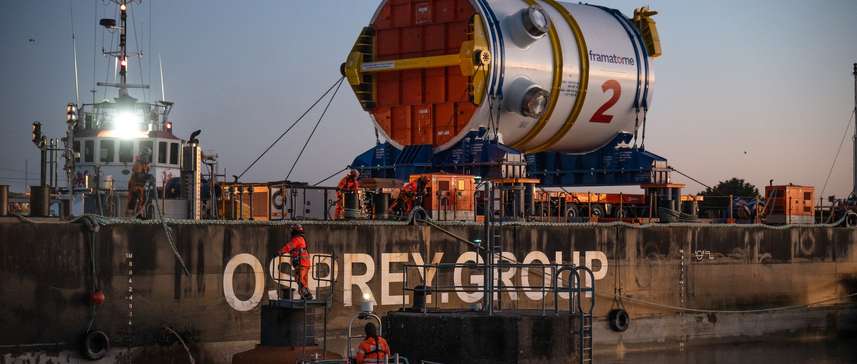
Osprey has successfully completed the transportation of the second Reactor Pressure Vessel (RPV) for Hinkley Point C, marking another major milestone in the delivery of the UK’s new nuclear generation.
Weighing 486 tonnes, the RPV is a critical component in the nuclear island. Its successful delivery required precise multi-disciplinary engineering, detailed planning, and execution across marine and land transport interfaces. Osprey’s integrated approach ensured the RPV arrived safely and on schedule, ready for onward installation.
From marine transport through to final on-site delivery. Specialist marine solutions enabled controlled shipment and river transit, with careful consideration of tidal, navigational, and environmental constraints. At the port interface, Osprey coordinated secure port marshalling operations, providing controlled handling, inspection, and readiness checks prior to onward movement.
The final stage of the journey utilised Osprey’s specialist heavy transport capability, deploying Self-Propelled Modular Transporters (SPMTs) to move the RPV from Combwich Wharf to site. This approach delivered millimetre-level control, enhanced safety, and reduced operational risk, ensuring seamless integration with site operations and installation readiness.
Crucially, the delivery of the second RPV builds on the proven logistics methodology developed for the first reactor unit. By replicating a successful transport model, Osprey supported programme certainty, reduced interface risk, and enabled lessons learned to be embedded into delivery. This repeatable, scalable approach underpins efficient nuclear construction and supports long-term programme resilience.

Tintagel, Cornwall
As a company, we’ve been responsible for many iconic projects. As part of a £5 million redevelopment of the site, in 2020, the then Duke and Duchess of Cornwall opened the new, elevated footbridge at Tintagel. In 2022, the installation won the Royal Fine Art Commission Trust’s 2022 Building Beauty Award. We were brought on board to engineer a solution for the delivery the numerous bridge sections, designed by Ney and Partners, installed by American Bridge.
This was a huge challenge. 28 metres higher than the original crossing and 72m in span, the new bridge would open up expansive views of the coastline and of the original land-link. The structure – 4.5m high where it springs from the rock face – tapers to a thickness of 170mm in the centre, with a clear joint between the mainland and island halves. It was expected to transform the visitor experience, and has done since its opening in 2020.
Legend has it, the original walkway of the 16th century was so narrow, three knights alone could have defended Tintagel Castle. When that link bridge collapsed, visitors had to trek up and down a steep path to access the ramparts. Designed for great longevity, the new infrastructure was fabricated in steel, oak and Cornish slate to bridge the 190 ft gorge – but the installation had to contend with a rugged clifftop landscape.
A conventional approach might have been to suggest road transport for the major part of this project. However, by using our flat top barges as an alternative solution, we were able to minimise risk and emissions, reduce the time frames involved and, reduce inconvenience to local communities. Once off-loaded, we used Self Propelled Modular Transporters (SPMTs) to transport each section of the new bridge along the narrow lanes and winding roads leading to the clifftop.
When the bridge also won a RIBA National Award in 2021, the jury commented: “Technical achievement and degree of difficulty metrics are high in this project where construction logistics and material specification have all been expertly handled. It also sets the bar very high above the potentially choppy waters of the competitions and commissioning process, standing out as an exemplar of how projects should be run, having been taken from concept to delivery without dither or delay. This is much more than a bridge. It is a connector, an enabler, an interpreter and a spectacle all within its own right.”
Hinkley Point C, Somerset
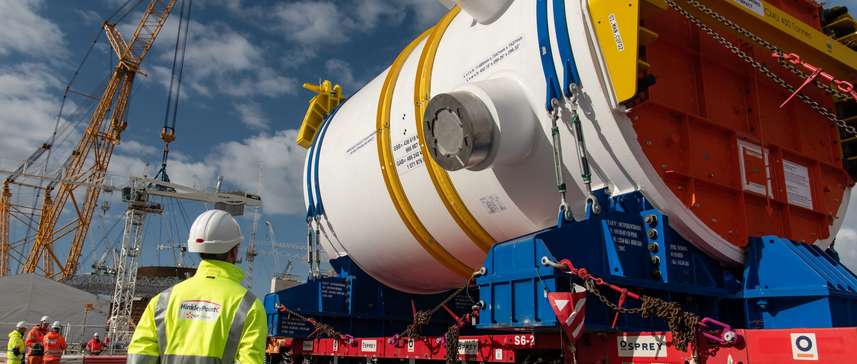
In February 2023, Osprey’s nuclear team co-ordinated the transportation of EDF’s new Reactor Pressure Vessel (RPV) in to Hinkley Point C (HPC).
Every safe delivery of an oversized asset to a nuclear construction site marks a milestone – it brings each project one step closer to providing nuclear energy to thousands of homes. Over the last three decades, it’s become clear that the importance of these new reactors cannot be underestimated as climate change and political landscapes prompt alternate decisions around energy supply.
With that in mind, we were thrilled to be appointed Tier 1 supplier to HPC – to co-ordinate, engineer and execute the most challenging heavy-lifts for supersized assets coming onto the site, just like these RPVs.
Weighing in at 500 tonnes and each one measuring 13 metres high, Reactor Pressure Vessels (RPV) are the large vessels that create the heat needed to make steam for the world’s largest turbine. When commissioned, HPC’s two RPVs will generate the electricity for almost six million homes. This was the first time in 30 years that a component of this significance had arrived in Britain (the last one, also manufactured by the French manufacturer, Framatome, was installed at Sizewell B in Suffolk).
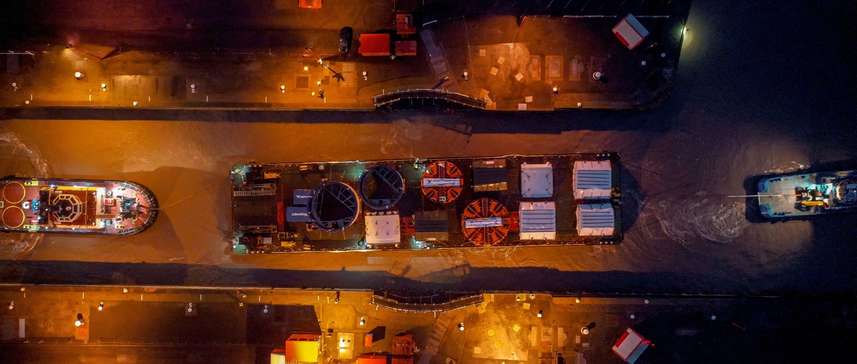
Combwich Wharf – our innovative ‘static RoRo’ solution for Hinkley Point C – is the key to bringing components like this onto the site. The River Parrett has a tidal range of 14 metres over 12 hours – the second highest tidal range in the world – which poses an enduring challenge for all AIL assets coming into the construction site this way. The solution itself took three years to engineer, but it overcomes huge environmental challenges, and has transformed the construction site’s AIL operational logistics, safety standards and productivity levels.
The first RPV unit arrived at Avonmouth Docks, where our barge team took safe possession and transported it to Combwich Wharf – there are many stakeholders and suppliers involved in transporting assets like this.
The next leg of the journey involved the five-hour navigation of a river that brings each RPV to Combwich Wharf, where it was off-loaded from our RO-RO solution and transported 4.6 miles by road to the EDF site using Self-Propelled Modular Transporters (SPMTs). Having moved from the wharf up to the main construction area, the RPV will now be stored safely and securely until it’s installed in the Reactor Building itself.
South West England
As a Tier 1 supplier, we look back with pride on many milestones in our work at Hinkley Point C (HPC). One of the earliest projects involved bringing two tunnel borers into the UK from Germany – both manufactured in a controlled, factory environment. This involved an ocean voyage and an innovative, inland waterway solution.
It was a great opportunity to demonstrate our ‘working better, together’ approach, which involves open learning. The lessons learned in our planning and execution can be used to inform other, similar logistics’ plans in the future.
At Osprey, we believe in ‘open learning’. It’s the right approach, to maximise our contribution to a sustainable future and Net Zero ambitions. The transportation of tunnel borers isn’t an everyday occurrence, but it is a milestone for nuclear construction. Our insights from the HPC move will be valuable to other nuclear project managers. It’s how we approach all of our projects – working better, together.