
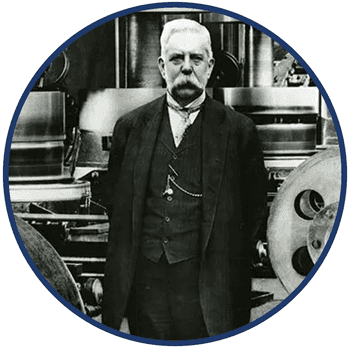
It began in the Age of Steam - a 19th century success story that resonates in the 21st century. George Westinghouse, a teenager with a head full of ideas, seized opportunity after opportunity to make technology better, faster and more efficient. In the process, he helped improve the way people live. He started a company, then another, then dozens of them. His ventures survived him and continued to evolve through decade after turbulent decade into forms he couldn't have predicted, but would no doubt have understood.
Born in Central Bridge, N.Y., Oct. 6, 1846, George Westinghouse was the eighth of 10 children. When the family moved to Schenectady, N.Y., his father established a shop for agricultural machinery and small steam engines. After serving in the Union Army during the Civil War, and briefly attending college, Westinghouse returned to his father's shop where, in 1865, he developed and patented a rotary steam engine. That same year he invented a device for placing derailed freight cars back on their track.
A continuing interest in railroads led Westinghouse to his first major invention. Observing the problems and limitations of stopping trains by manually-operated brakes, he devised a method of using brakes actuated by compressed air. He turned this idea into the Westinghouse Air Brake Company, founded in 1869.
A well drilled in the yard of Westinghouse's home led to several dozen inventions for the control and distribution of natural gas. His ideas were the basis for founding a company to distribute gas in the Pittsburgh area. Knowledge gained from this work pointed him in the direction of a better distribution system for electric current. He had invented a reduction valve that permitted high-pressure gas from the well to be delivered at low pressure at the point of use. He reasoned that a similar device could work with electricity, and he found it in a so-called secondary generator developed in England. With skilled associates like William Stanley, he turned the crude secondary generator into a transformer that proved to be the key to widespread distribution of electric power.
His firm faith in the alternating-current system led to the founding of the Westinghouse Electric Company in 1886, which was in bold opposition to the well-entrenched backers of the direct-current system, led by Thomas Edison. But in a span of just 10 years, the value of the alternating-current system had been convincingly demonstrated. By the turn of the century, Westinghouse's enterprises had grown to employ over 50,000 workers.
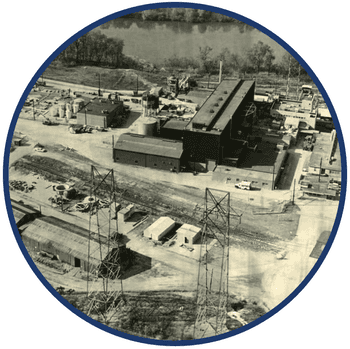
Westinghouse supplied the world’s first commercial pressurised water reactor (PWR) in 1957 in Shippingport, Pa. Today, there are more than 430 nuclear power reactors in operation worldwide, with a net installed capacity of 370,543 MWe. Westinghouse technology is the basis for approximately half of these reactors, giving Westinghouse the world’s largest installed base of operating plants.
Acclaimed in his time as the "greatest living engineer," George Westinghouse was accorded numerous honours in the U.S. and abroad, even after his death on March 12, 1914.