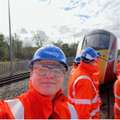
Since I was quite young, I have held an interest in the railway. I undertook a Year-In-Industry which I thoroughly enjoyed. I got numerous opportunities in terms of placements, training and involvement on projects which demonstrated to me Network Rail in the long-term would be supportive of my development as an engineer. I had an excellent line-manager and team which I still have now which I really enjoy being a part of. The scheme’s structure in terms of the different placement opportunities, technical training and support for Chartership were all key in my decision-making process.
Additionally, my line-manager and other managers who had worked with me before had spoken to me as early as October of my Year-In-Industry to bring me back on the Graduate Scheme and they allowed me to give feedback to how the new Engineering Services Graduate Scheme would run. This showed me they were keen to invest in me as an individual and as an engineer.
A great thing about the Network Rail graduate scheme is there is no ‘typical day in the life’, especially as a national graduate within Route Services.
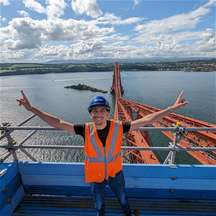
Most of my friends in grad schemes outside of NR only stay in one location, focusing on their specific job title (such as CAD Operator Grad Scheme) but on the NR grad scheme one day you could be at the top of the Forth Bridge and underground in a mine!
It has improved my technical skills in terms of learning about my discipline in E&P, I think skills like report writing, CAD, Excel I already learnt at university but where I have really improved is my interpersonal and teamwork skills when working with different people. Network Rail has such a diverse workforce and learning to work with different professionals of different backgrounds and skillsets has been a great learning curve.
My confidence in being able to complete tasks by myself and also find resources has greatly improved. At university we learn the theoretical side of engineering but whilst being at Network Rail I have learnt how it is applied to real-world applications, a huge part of that is working with people, using different systems, databases and standards.
I have been involved in numerous design projects, including for electrification, new railway lines and new rolling stock being introduced on the network. From these projects, I have contributed to technical reports which have been sent to clients.
I have contributed to the new Traction Decarbonisation Network Strategy report that will be released to the public in due course.
On West Coast South with Asset Management, I was involved daily with investigating faults and assisting the delivery units solve these issues.
I have also been involved with dealing with the latest audit on the Central route for OLE, rectifying issues to become compliant.
Excellent. You get support from your line manager, graduate manager, delivery coach, mentor, host managers, lead buddies and fellow graduates. Within the team, your colleagues are usually always happy to help unless they are very busy. I cannot fault the support I have received.
The biggest challenge I have faced is learning to adapt to different environments and colleagues within the railway. The railway is such a large and diverse workforce meaning you will meet people from all types of backgrounds. For example, people who work in maintenance on the front line will work very differently from the senior leadership team in the office. I have had the opportunity to work on the front line and be involved in director-level meetings, both experiences were very different and learning to adapt to different situations has been a good learning process.
I have enjoyed working on multi-disciplinary projects where different disciplines are involved on projects that will improve the future of the railway whether that be introducing greener trains onto the network or new stations to better connect communities with public transport. Projects that directly make a difference to the customers we serve every day!
I held an interest in the railway before, since my first year of university it was an ambition of mine to work on the railway on the infrastructure side. Network Rail are the infrastructure owners for the railway, so it made sense.
I believed when I was going to join as a mechanical engineering graduate I would be working mainly with fleet, but there are many different applications of mechanical engineering within the railway. Additionally, a lot of host managers have told me they believe in reality given enough support, guidance and drive to want to learn I could undertake tasks with any discipline.
In terms of NR and the railway in general, people always blame NR or the TOCs for delays or cancellations, but I think sometimes the criticism is unfair. We cannot predict or help human behaviours which might cause delays or cancellations, neither can we control the weather or other events which might cause problems on the network. There is so much more that goes into why trains have delays and cancellations, it is not simply Network Rail’s engineers at fault!
Apply for schemes that you are interested in because your career is long, and I believe you do not want to be waking up not wanting to go into work or not being interested in what you do. There has genuinely never been a day I have woken up whilst at Network Rail where I have not wanted to go into work or not looked forward to what the day might bring. I cannot stress enough, that work takes a large part of your life, and it is really important to not just apply to jobs and schemes for the sake of it but to give thought to what you actually want to do and where you see yourself within your career.
I did not do an application for the graduate scheme; I was offered a role formally back at Network Rail one month after I left my Year-In-Industry.
For my Year-In-Industry the application process was difficult as it involved quite a few different stages. However, it was better than the other application processes I had for other companies as the communication was better and the assessment centre was organised better. The people interviewing me also made me feel a lot more comfortable but a large part of it being an easier application process was me having a prior interest in the railway.