
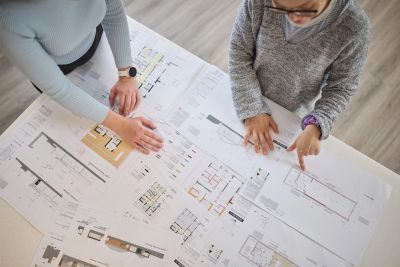
From schools and homes to laboratories and motorsport facilities, architects combine creativity, technical thinking and problem-solving to design buildings and spaces that are functional, sustainable and stand the test of time.
If you’re creative, enjoy thinking visually and like exploring different design possibilities, architecture blends artistic flair with real-world impact. From early sketches and concepts to completed buildings, you’ll watch your designs become part of the places people live, work and spend time in.
Related (but non-essential) graduate degrees:
Art and Design
Design Technology
Maths
Physics
Creativity and communication
Apprentice → Architectural Assistant Part 1 → Architectural Assistant Part 2 → Architectural Assistant → Architect → Senior Architect → Associate → Partner.
Curious about how buildings work and why they change over time?
Building surveyors inspect properties, identify issues and help clients plan repairs, improvements and new uses across a building’s life.
With a mix of office and site work, no two days are the same. It’s a great choice if you enjoy variety, investigating how things work and finding practical solutions. You’ll work closely with clients from an early stage of your career, get involved in projects from concept to completion and build the skills and experience you need to progress towards professional Chartership.
"I look back at the surveyor I was less than six months ago and I’m vastly better because of the experience and support I’ve been given, which I can then give to others."
Luke Johnson, Graduate Building Surveyor, London
Related (but non-essential) graduate degrees:
Entry requirement (any of the below):
Apprentice → Building surveyor → Senior building surveyor → Associate → Partner.
Civil engineers shape the infrastructure that surrounds us.
From designing roads, bridges and drainage systems to supporting projects through design and delivery, they turn ideas into places and spaces that people use every day.
If you enjoy practical problem-solving and want to see how your work influences the world around you, civil engineering could be for you. With a mix of technical thinking, collaboration and variety, you’ll work on projects that leave a lasting mark on the places we live, work and travel through.
"I first heard about the programme while on a six-month placement with the civil engineering team. They mentioned the possibility of starting an apprenticeship with them so that I could switch careers after completing my architecture degree."
Jessica Ridley, Apprentice Civil Engineer, Bristol
Related (but non-essential) graduate degrees:
Entry requirement (any of the below):
Apprentice → Civil Engineer → Senior Engineer → Associate → Partner.
Every project relies on good decisions, and cost and commercial managers are at the heart of making them.
They work with clients and teams to plan, manage and control costs, making sure projects deliver the best possible outcomes and stay on budget. Throughout a project’s lifecycle, they balance cost, value and long-term sustainability to shape key decisions.
If you enjoy working with numbers and are interested in understanding the commercial side of projects, you’ll feel right at home here. You’ll weigh up different options, make recommendations and see how your decisions shape a project’s success.
"I’m currently working towards my Chartership and have access to a range of training courses to support me along the way. I’ve also received a huge amount of support from colleagues across the business, who are always willing to share their knowledge, insights and guidance with someone at the early stages of their career."
Elisha Jassal, Graduate Quantity Surveyor, Reading
Related (but non-essential) graduate degrees:
Entry requirement (any of the below):
Apprentice → Quantity Surveyor → Senior Quantity Surveyor → Associate → Partner.
This is a clear, recognised professional pathway via RICS. There are early opportunities to take on commercial responsibility and develop your career.
Digital engineers use technology to make projects smarter, more connected and easier to deliver.
From managing project data and digital models to improving collaboration between teams, they bring clarity to complex information so everyone can work from the same trusted source.
If you’re excited by technology and enjoy exploring new ways to solve problems, digital engineering puts you at the forefront of how projects are delivered. You’ll turn data into insight, improve the way people work together and give project teams the information they need to make better decisions from start to finish.
Related (but non-essential) graduate degrees:
Entry requirement (any of the below):
Apprentice → Digital Engineer → Senior Digital Engineer → Associate → Head of Digital.
Please note: you may need to complete a Level 4 qualification before progressing to the degree apprenticeship.
Fire engineers make buildings safer for the people who use them.
They assess risks and develop fire safety strategies for both new developments and existing properties, shaping how they are designed, built and managed.
If you’re interested in how buildings perform and enjoy analysing risks, you’ll find plenty to get stuck into. Few disciplines combine technical thinking with such a direct impact on people’s safety.
Related (but non-essential) graduate degrees:
Entry requirement (any of the below):
Apprentice → Fire Engineer → Senior Fire Engineer → Associate → Partner.
Every project starts with understanding what’s already there.
Geospatial specialists use surveying technology, laser scanning and digital modelling to capture accurate information about buildings, land and infrastructure, giving design teams a reliable foundation to build from.
If you’re fascinated by maps, data and technology, geospatial brings all three together. Using CAD and other software, you’ll analyse data and see how accurate information shapes future developments from the very beginning.
Related (but non-essential) graduate degrees:
Entry requirement (any of the below):
Apprentice → Geospatial Consultant → Senior Consultant → Associate → Partner.
The best safety decisions are the ones made before work begins.
Health and safety consultants work alongside clients, designers and delivery teams from the earliest stages. They identify and manage risks, influence decisions and make sure safety is considered throughout the design, construction and ongoing use of a building.
If you’re naturally curious, enjoy working with others and like finding practical solutions to complex challenges, you’ll find plenty to enjoy here. It’s a role where strong communication and sound judgement have a direct impact on people’s wellbeing, creating safer places for those who build, use and maintain them.
Entry requirement (any of the below):
Apprentice → Health and Safety Consultant → Senior Consultant → Associate → Partner.
Some of the most important parts of a building are the ones you never see.
From designing heating, cooling, ventilation, lighting and power systems to integrating renewable energy technologies, MEP engineers combine technical know-how with creative thinking to make buildings work better for the people who use them.
If you’re curious about how things work and enjoy solving technical problems, this could be a great fit. You’ll use your skills to create more sustainable buildings that are comfortable, efficient and built for the future.
"I’m involved in early-stage designs, coordinating with architects, civil and structural engineers to figure out how services will fit within a building. We also have regular CPDs and training sessions with manufacturers, so it’s a great mixture."
Isabelle Jee, Apprentice Building Services Engineer, Manchester
Related (but non-essential) graduate degrees:
Entry requirement (any of the below):
Apprentice → Engineer → Senior Engineer → Associate → Technical Director → Partner.
Project managers turn plans into action, keeping projects on track from start to finish.
They lead planning and coordination, working with clients, contractors and teams to manage priorities, budgets and timescales.
If you’re organised, enjoy juggling priorities and thrive on responsibility, project management has plenty to offer. Strong communication skills and a collaborative mindset will help you build relationships, overcome obstacles and keep projects moving forward.
"I recently led a meeting for a new project and was really nervous about it. I was still getting to grips with the subject matter. Afterwards, one of the architects stopped me in the kitchen to say, ‘You did amazing, well done.’ Those small moments of support really build your confidence."
Alice Messer, Graduate Project Manager, Oxford
Related (but non-essential) graduate degrees:
Entry requirement (any of the below):
Apprentice → Project Manager → Senior Project Manager → Associate → Partner.
This is a recognised progression route through the RICS or APM pathway. There are early opportunities to take on responsibility, work closely with clients and develop leadership skills throughout your career.
From homes and schools to business parks, regeneration schemes and infrastructure, planners shape the future of towns, cities and neighbourhoods by guiding developments through the planning process.
If you’re fascinated by how communities evolve, planning offers the chance to shape them. You’ll combine research, strategic thinking and collaboration, with the opportunity to influence places for years to come.
"I’m working on a couple of supported living applications, and those are the schemes where you feel you’re genuinely making a difference. Getting them approved enables adults with additional needs to live more independently, which makes the work feel incredibly rewarding."
Cleo Jefferies, Assistant Planner, Cheltenham
Related (but non-essential) graduate degrees:
Graduate Planner → Planner → Senior Planner → Associate → Partner.
From bridges, schools and high-rise developments to the hidden elements that support them, structural engineers make buildings and infrastructure safe, efficient and sustainable.
If you’re an analytical thinker who enjoys understanding how things are built, structural engineering could be an ideal choice. Combining technical thinking, creativity and advanced 3D modelling tools, you’ll refine designs, push boundaries and bring bold visions to life.
"Take any opportunity to learn or see something new. Say yes, whether it’s a site visit or a CPD session. It’s much easier when you have a real-life understanding of what you’re learning in the classroom."
Harri Morgan, Apprentice Structural Engineer, Cardiff
Related (but non-essential) graduate degrees:
Entry requirement (any of the below):
Apprentice → Structural Engineer → Senior Engineer → Associate → Partner.