Discover our ongoing innovation journey. See how the network has unified technologies, setting the stage for the digital transformations to come in the AI era.
Four decades ago, computers barely communicated. Today, the network connects nearly everything - satellites, power grids, and phones. Even our ovens. We rely on it every day without noticing how deeply it has shaped - and continues to shape - our world. Its first forty years built the foundation, forging a universal language of connection that has become our global digital nervous system.

In the 1970s and '80s, the idea of computers talking to each other seemed like science fiction. Then came TCP/IP (1983), a common language for networks championed by Vinton Cerf and Robert Kahn. Soon, the Domain Name System mapped numeric addresses to readable names. In 1984, Cisco started with a simple idea to link two disparate networks to connect and share information.
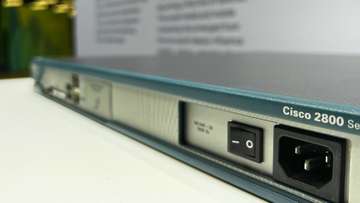
Our first multiprotocol router (1986) let different networks communicate, becoming a cornerstone of the emerging internet backbone. These breakthroughs enabled email, streaming, global e-commerce, and everything that followed. From the start, the network showed a pattern: it didn't just connect; it unified technologies and standards, setting the stage for the digital transformations ahead.
By the '90s, the internet entered our homes. Tim Berners-Lee's World Wide Web (1991) and user-friendly services like AOL helped millions explore the digital world. This era sparked online shopping, email for everyone, and even the first hints of cybersecurity's importance. Early wireless standards (like IEEE 802.11 in 1997) freed us from cables, paving the way for Wi-Fi, mobility, and the seeds of remote work. Voice over IP (VoIP) began shifting phone calls online, and tools like CU-SeeMe hinted at a future of video collaboration.
By the mid-2000s, the network enabled an age of constant connectivity. Facebook (2004) connected people worldwide. Apple's iPhone (2007) put powerful computing in our pockets, normalising a world of apps and social media on the go. Cisco's TelePresence showed how seamless remote collaboration can be, with early holographic experiments foreshadowing future breakthroughs.
By the late 2000s, billions of devices were generating massive amounts of data. The network evolved again, not just transmitting information, but analysing and reacting to it in real-time. IoT devices - wearables, smart home thermostats, factory sensors - all relied on the network to function intelligently and instantly. Fog computing, pioneered by Cisco, brought processing closer to devices, reducing latency and making networks more agile. The network integrated IoT, cloud, and analytics to deliver insights and services at scale.
A new decade confronted the world with a challenge unlike anything seen in many of our lives - a global pandemic. Online became the frontline in an almost overnight pivot to video calls and remote work. A highly resilient, globally scalable infrastructure kept people, communities, and businesses connected. Hybrid work became the norm for many. Education, business, healthcare, and social interactions have evolved beyond recognition and at a record pace. Life is more digital than ever.
Today, high-speed connections and chips, like Cisco's Silicon One, support complex AI workloads. As AI soared, so did the complexity of securing our networks. GenAI tools appeared almost overnight, rewiring how we work, live, and play while raising new privacy and security risks.
Cisco responded with AI-native security solutions like Cisco Hypershield, to protect data, devices, and applications across every environment, and AI Defense, an end-to-end solution that protects the development and use of AI applications, so enterprises can advance their AI initiatives with confidence.