

Added: 29th April 2026 by Cambridge Consultants
Our task was to rise to a challenge set by the Defence and Security Accelerator (DASA), part of the UK government Ministry of Defence. The organisation sought innovations that would deliver a step change in military logistics capability across maritime, land and air domains. The autonomous behavioural engine we demonstrated to them enables fast and safe unmanned logistics in congested, dynamic environments.
We utilised virtual environments to train the algorithm, before implementing it to our platform. This significantly reduced the time and cost for training and avoided the reliance on capturing high quality real-world data.
During the Dstl trial, we also took advantage of simulation to showcase how an autonomous vehicle would deliver goods across a busy Sea Port of Disembarkation (SPOD).
Having provided virtual evidence of the autonomous behavioural engine performing in a complex and dynamic environment we then showed the system operating ‘live’ with our demonstrator robot to the event’s audience.
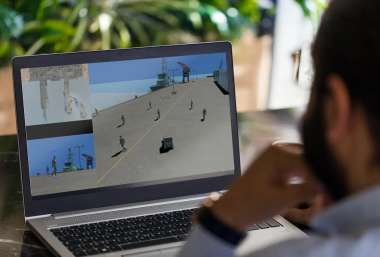
Our behavioural engine combines AI-based navigation with custom reinforcement learning. Its learned human behaviour predicts where people will go. It then uses that judgement to make its next move.
This happens in real time, allowing a robot to negotiate the fastest route with no pauses, no stops and less downtime. We’ve been careful to constrain the robot to move only in human-like ways, which results in greater levels of acceptance and trust from those sharing its environment.
The logistics hubs, warehouses and facilities of the military supply chain are crowded and dynamic, with personnel, vehicles and mechanical loading equipment constantly on the go.
Any autonomous system must deal with this complexity – and be effective, fast and trusted by the people around it. This is where our technology comes to the fore. It mimics the way humans navigate congestion, predicting movement and finding the fastest route as they go.
This is contrary to typical approaches which have proximity sensors to stop a robot when people are close, thus hindering progress in busy environments.
We shared the innovation as part of the ‘Right on Time: Automating Military Logistics’ competition run on behalf of the Defence Science and Technology Laboratory (Dstl) by DASA. As well as recognising its relevance, organisers said that assuring the system and developing an appropriate safety case would be a key stakeholder consideration.
It was also felt that more testing is required and that additional capabilities need to be added – considerations that the CC team agree with and are discussing.
Our solution was originally envisaged to enable robots to navigate through crowded environments such as theme parks or airports. The DASA project came along at just at the right time for us to demonstrate its utility in applications associated with automating logistics in defence.
It also presented the opportunity to receive live feedback on our prototype and technology framework. A truly valuable exercise indeed.